

5 Steps to Rewire Old Thought Patterns
Small Daily Shifts To Change Your Brain


14-week Rewired Healing Series- Week 7
Rewiring the Thought Patterns Trauma Left Behind
If you’ve ever felt stuck in the same harsh thought loops — this week’s post is for you.
⚠️ Trauma-Informed Reminder
Some of what’s shared here might bring up strong emotions or old memories. Please go at your own pace.
✔️ Pause or step away if you feel overwhelmed — that awareness is part of healing.
✔️ Use grounding tools if your body feels tense (a few deep breaths, stretching, or orienting can help).
✔️ Skip this entirely if it doesn’t feel safe for you today. Your emotional safety comes first — always.
📚 Summary
Last week, we talked about that harsh inner voice — the one you learned to use to stay safe.
This week, we’re moving from understanding it to rewiring it — gently teaching your brain a new pattern that feels safer, calmer, and more supportive than those old survival loops.
In this post, you’ll learn:
✔️ Why your survival brain jumps to worst-case scenarios (and why that’s not your fault)
✔️ How to start creating new pathways with small daily shifts
✔️ Simple tools to help your brain feel safe enough to change
Because your brain isn’t broken — it’s protective. And if it could learn to be harsh, it can learn to be kind.
Last week, we learned the truth about that harsh inner voice — it isn’t who you are, it’s who you had be to feel safe.
This week, we’re moving from understanding it to rewiring it.
Not by forcing fake positivity or shutting the critic down, but by gently teaching your brain a new pattern — one that feels safer, calmer, and more supportive than the old survival loops.
Every pause, every new thought is a signal to your brain:
“We don’t have to live in survival mode anymore.”
So how do you start changing old thought loops?
By making small, repeated choices that teach your brain it’s safe now. Rewiring isn’t about guessing or hoping — it’s about following proven steps that signal safety to your nervous system until it starts responding differently.
Here’s how you do it:
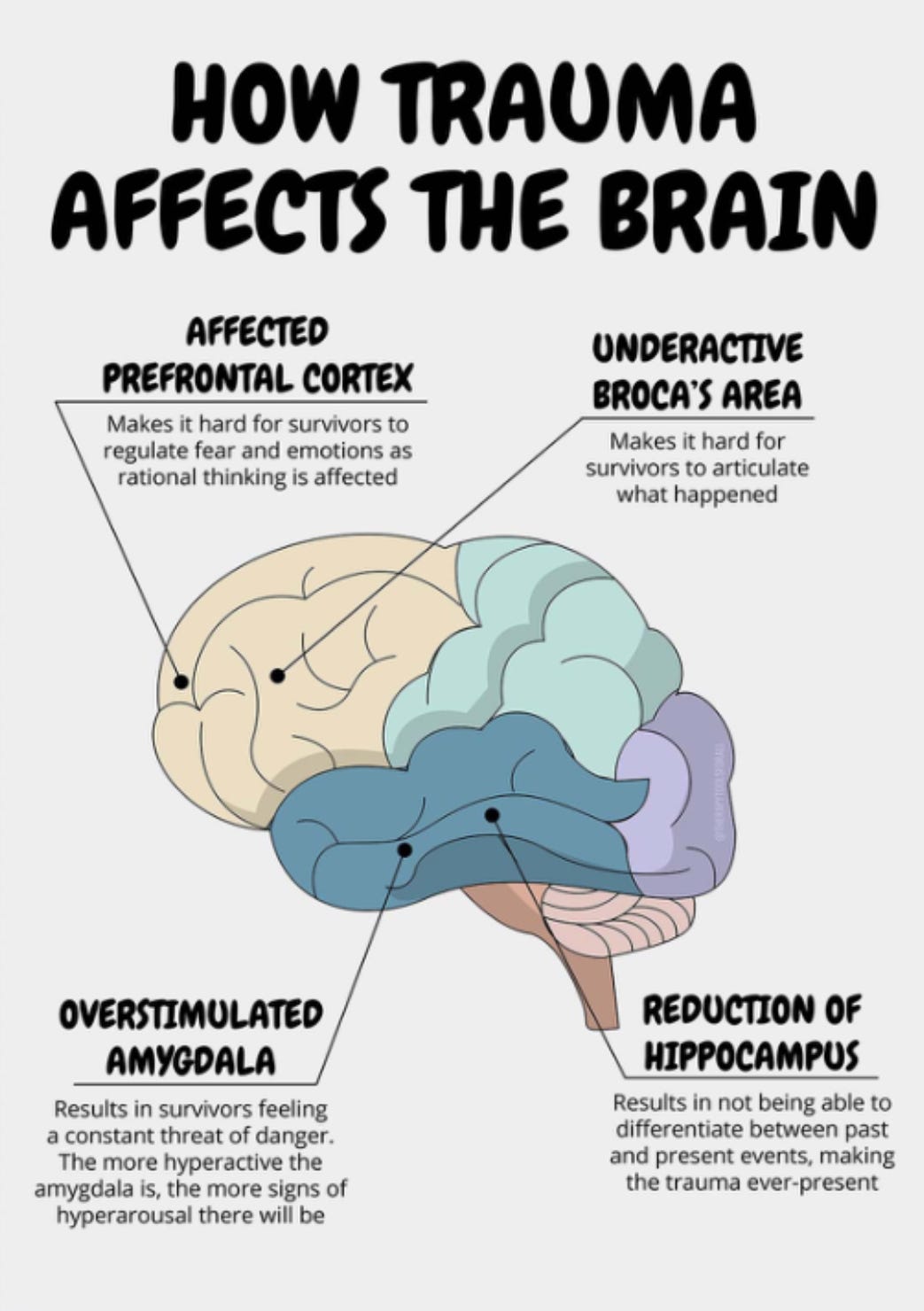
1. Understand What’s Happening in Your Brain
Your brain is a prediction machine. Its job has always been to keep you alive — not necessarily happy or calm.
When you’ve lived through chronic stress or trauma, it learned to prioritize survival over accuracy:
The amygdala (your alarm system) stays on high alert, scanning for danger.
The hippocampus (your memory center) links certain emotions and sensations with past threats, even if today’s situation is safe.
The prefrontal cortex (your reasoning brain) goes quiet when your nervous system senses danger — which is why logic disappears in the heat of the moment.
Broca’s area (the speech and language center) can go partially offline during high stress, which is why it’s so hard to find the right words or explain what you’re feeling when you’re triggered.
So when you think…
“I should’ve done better.”
“They’re upset — I must have done something wrong.”
“I can’t handle this.”
…it’s not because you’re broken. It’s old wiring firing first.
The good news? Neuroplasticity means your brain can change.
Understanding this is the foundation for change. You can’t rewire what you don’t first recognize.
2. Recognize Survival Patterns That No Longer Fit Your Life
Those harsh thoughts were once protective — shortcuts your brain built to keep you safe.
Think about the ones that show up for you. Many of us learned survival patterns like:
Criticizing ourselves first to avoid getting in trouble.
Expecting rejection to prepare for disappointment.
Predicting worst-case scenarios to feel ready for anything.
What patterns do you notice in yourself? Which ones might have kept you safe back then but feel heavy or unnecessary now?
Naming these patterns for what they are — survival, not who you truly are — is the first step to loosening their grip.
3. Calm Your Body Before You Change Your Thoughts
Safety comes before logic. Every time you notice a harsh thought:
Place your hand on your heart or legs.
Take one deep breath (longer exhale than inhale).
Remind yourself: “This is old wiring talking. I get to choose differently now.”
You’re pairing body safety + new thought, which is the fastest way to rewire.
Even starting with just one pause a day begins to teach your brain something new: you’re safe enough to slow down, and you don’t have to react the old way anymore.
The more often you practice, the stronger this new pathway becomes.
4. Offer Your Brain a Kinder Option
Rewiring isn’t about “thinking positive.” It’s about giving your brain safer choices:
❌ “I always mess this up.”
✅ “This is my younger brain trying to protect me. I can slow down and choose differently.”
❌ “They’re mad at me.”
✅ “My nervous system feels unsafe right now — but that doesn’t mean I did anything wrong.”
❌ “I can’t handle this.”
✅ “This feels hard, but I can handle it one step at a time.”
At first, it will feel awkward — like writing with your non-dominant hand. But every time you do this, you’re strengthening the new pathway and weakening the old one.
5. Repeat Daily to Build New Pathways
Your brain learned harsh patterns through repetition — so you need to teach it safety the same way. There are two ways I do this:
Meditation
I started meditating over five years ago, and it quickly became part of my morning routine. I’ve meditated every single day since — but it does NOT have to be daily for it to help. Meditating — even just a few times a week — can start teaching your brain it’s safe to slow down and begin to rewire.
The real benefit comes from getting into the habit of spending time alone in a calm, quiet environment where you can notice your thoughts. My friend does this while swimming because she doesn’t like to sit still.
The point isn’t how you do it — it’s giving yourself a quiet space to examine your thought patterns without judgment and teach your brain that slowing down is safe.
Daily Affirmations
I also listen to the same 15-minute affirmation every morning — in the car alone, where I have no interruptions and can turn it up loud. I’ve been doing this nearly every day since the end of last November, and over time, her soft voice has started echoing in my own thoughts.
You don’t have to believe every word right away. Just repeating kinder thoughts tells your brain: “I am safe now.”
If you want to try what I use, here’s the exact video by Lavendaire:
(I’m currently looking for a great men’s version — if you know of one, please share it in the comments or DM me.)
The more consistently you practice, the more your brain will default to safety instead of survival.
You’re Allowed to Think Differently Now
Every pause you take — every kinder thought you offer yourself — is proof that you’re already changing. Even if it doesn’t feel that way yet, your brain is re-learning.
The harsh thoughts may still show up, but they don’t have to take control anymore.
YOU get to lead now — with curiosity, kindness, and choice.
Next week, we’ll dive into Triggers & Protective Parts — why they show up, what they’re trying to do for you, and how to work with them instead of against them.
For now, celebrate every small shift. Every pause counts. Every new thought is proof that you’re already changing. ❤️
💬 Your Thoughts
What’s one old thought you’d love to start rewiring — and what’s one new thought you want to practice this week? Or, if you’ve already started, what’s worked for you?
P.S. We read every reply — if you feel like sharing how this landed, hit reply and tell me. We love hearing from you.
Coming Thursday:
Today, I shared why your brain fires off those old survival loops. On Thursday, I’m sharing how I’m actually rewiring them in real life — the 3 tools I use every single day, including:
✔️ The Daily Rewiring Journal Sheet I fill out every morning (printable included)
✔️ A 1-minute “Micro-Rewire” practice for busy or overwhelming days
✔️ The simple morning routine that’s changed the way I talk to myself
If you’re ready to go deeper and start practicing this yourself, you won’t want to miss it.
♥️ If this resonated with you… or made you feel seen
We’d love to have you stick around.
FREE SUBSCRIBERS get weekly posts like this — with trauma-informed education and practical nervous system tips.
PAID SUBSCRIBERS get even more: growing library of resources — including printable worksheets, daily practices, and deeper personal posts on what’s been most effective in my own healing. Includes full access to the Rewired Healing Series.
No pressure — just extra support if and when you need it. Cancel anytime.
♥️ Need to Catch Up on the Series?
Grab all the posts in one spot:
🔗 Click Here: ReWired Healing Series Hub
Make sure you're subscribed — free or paid — so you don’t miss next week’s posts on Triggers & Protective Parts and all the guided tools and support that come with it.
📌 About Us:
We’re Kristin & Travis Francis — founders of Complex PTSD Warrior.
We provide trauma-informed education and support for healing your nervous system, repairing relationships, and breaking generational cycles — using curated tools rooted in neuroscience and lived Complex PTSD experience.
Our mission is to spread Complex PTSD Awareness, Education & Tools around the world.
If this post helped you feel seen, understood, or less alone — we’d be so grateful if you shared it with someone who might need it too.
It might be the message they’ve been waiting their whole life to hear.

Disclaimer: The content shared here is for educational and informational purposes only and is not a substitute for professional mental health care, diagnosis, or treatment. Please go at your own pace, and always prioritize what feels safe for your body and nervous system. If you’re in crisis or need immediate support, please reach out to a licensed mental health provider or crisis resource in your area.
You need to face your past before wiring your thoughts. That is what I am doing now.