

Getting Unstuck: How to Be The Loving Adult You Always Needed
5 Ways To Build a Bond With Your Younger Self

Paid subscriptions to Complex PTSD Warrior support expanding access to trauma-informed care for underserved communities. Thank you for being a part of my mission.
⚠️ Trauma-Informed Reminder
Some of what’s shared here might bring up strong emotions or old memories. Please go at your own pace.
✔️ Pause or step away if you feel overwhelmed — that awareness is part of healing.
✔️ Use grounding tools if your body feels tense (a few deep breaths, stretching, or orienting can help).
✔️ Skip this entirely if it doesn’t feel safe for you today. Your emotional safety comes first — always.
Last week, we talked about why we often feel like a child in our adult bodies:
‘I Still Feel Like A Little Kid Inside: Why We Get Stuck in Our Trauma Age’
'I Feel Like A Little Kid Inside: 16 Scripts to Share With Your Safe People'
We learned that our nervous system “freezes” us at the age of our core trauma to keep us safe. It’s a brilliant survival strategy, but it leaves us feeling powerless as adults.
One question I get asked most about this is:
“I often feel like a 7-year-old inside... how do I stop feeling like this?”
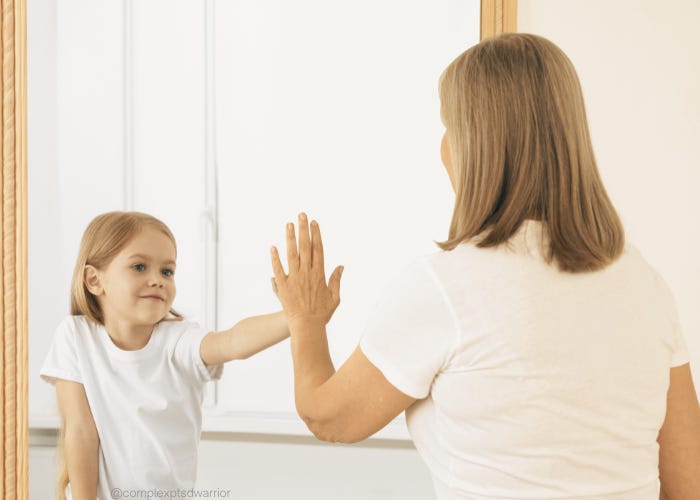
The answer isn’t to push your 7-year-old self away. The answer is showing up as the Wise, Loving Adult you always needed.
The idea is that your are stepping into the role of the protector for your own inner child and providing the safety and validation you were denied back then.
When that younger part of you feels truly seen and protected by you, your nervous system can finally exhale and move out of survival mode.
🧠 Reparenting Your Inner Child
1. Consistency over Intensity
Healing happens in the tiny, boring moments where you choose to be kind to yourself instead of critical. My daily morning ritual of waking up every day to do my inner healing practices.
My personal anchor: My 4:30 am ritual is where the real work happens. While it might just look like quiet healing practices and brain puzzles from the outside, it’s actually me building that steady, boring consistency. It’s the quiet act of choosing me before the world demands I choose it.
This shift in how you treat yourself eventually transforms your entire internal belief system. It’s this steady consistency of daily practices such as meditation, positive affirmations and positive self-talk that finally builds the self-trust that allows you to set boundaries and build healthy, secure connections.
2. The Body-to-Brain Highway
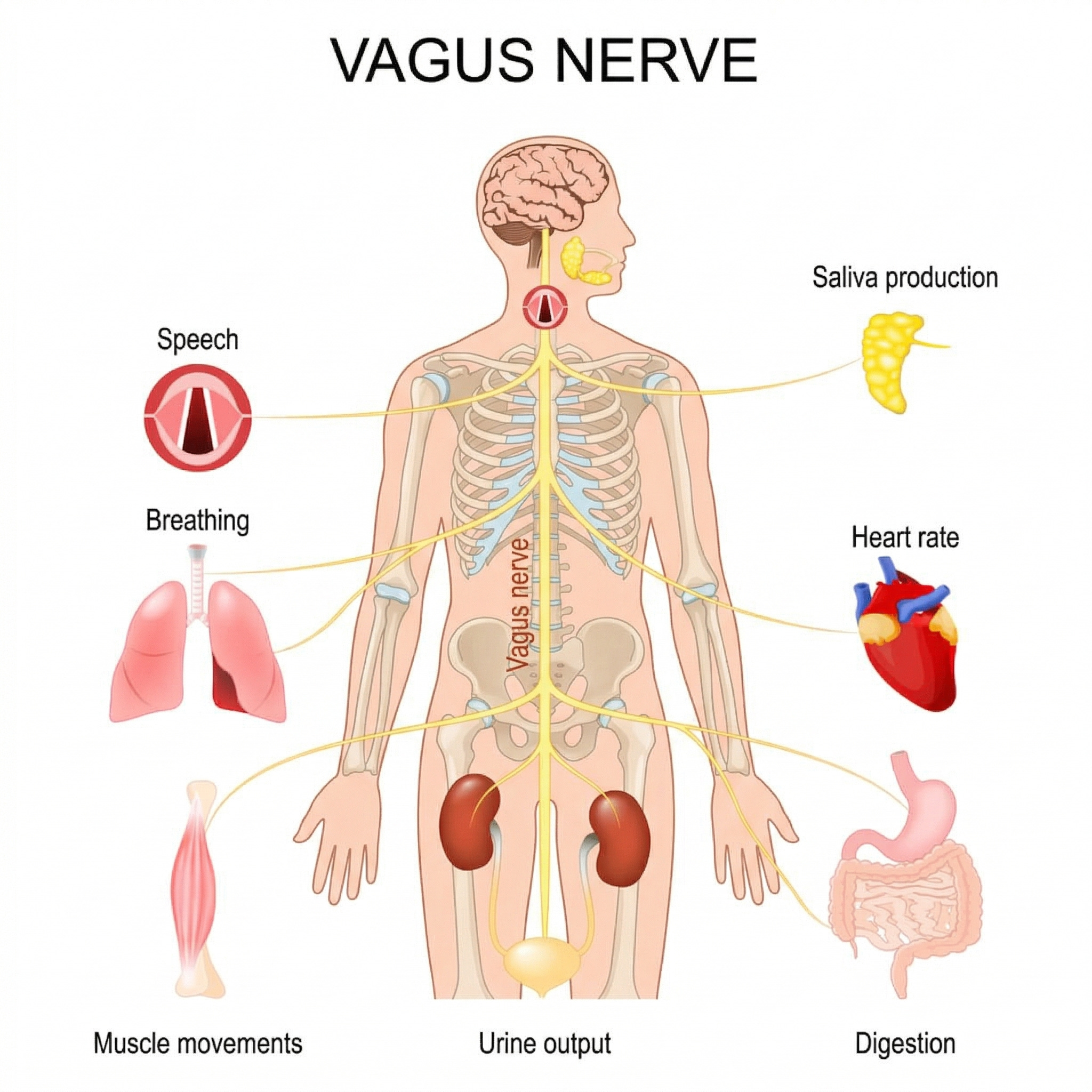
80% of the messages traveling along your Vagus Nerve go from the body UP to the brain.
If your body feels “danger,” your mind can’t just “think” its way into feeling safe. We have to teach the body it is safe first.
Wait, what’s the Vagus Nerve?
Think of the Vagus Nerve as your body’s internal “Information Superhighway.” It’s a long nerve that connects your brain to almost every major organ.
In a safe state: It’s like a smooth, clear road that tells your heart to beat slowly and your stomach to digest food.
In a triggered state: It’s like a sudden traffic jam or a siren going off. It’s why your stomach “drops” when you’re nervous, your throat feels tight, or you suddenly lose your words. Your body is signaling “Danger!” to your brain through this nerve before you’ve even had a conscious thought.
Example: The “Email Anxiety”: You see a notification on your phone and your stomach immediately ties itself in a knot.
The Body-to-Brain Shift: Your gut sends a threat signal up to your brain. Even if the email is just a simple question, your brain is now operating from a “survival” lens because your stomach told it to. You aren’t “being dramatic” - your body is simply reporting a perceived threat.
3. The “Name It to Tame It” Shift
When we are triggered, our survival brain (the Amygdala) takes over, and our logical brain goes offline. This is why we feel like we’re literally “back in time.” By simply naming the feeling - out loud or in your head - you help your brain move from a state of panic to a state of observation.
Your Loving Adult says: “I notice that my chest feels tight and I’m feeling really small right now.” This tiny act of naming the sensation pulls you back into the present moment. It reminds your system that you are the Adult observing the feeling, rather than the Child being consumed by it.
💡 Why this is so important:
When we understand that our body is the one “driving the bus” 80% of the time, we stop being so hard on ourselves for having “irrational” thoughts.
The Loving Adult says: “Oh, I see my stomach is in a knot. My body thinks we’re in trouble. Let me take a deep breath and do a Butterfly Hug to show my body we are actually okay right now.”
✋ 5 Ways to Practice Reparenting Today
The Tone Shift: When you make a mistake, notice if your “inner parent” sounds like your actual parents. Reparenting is consciously choosing a warmer, kinder internal voice.
Physical Self-Soothing: Giving yourself a butterfly hug (see below), using a weighted blanket, or rocking side-to-side are ways of offering your body the co-regulation it missed out on.
Basic Needs Check-In: Often, we ignore our hunger, thirst, or bathroom needs - a habit from a time when our needs didn’t matter. Asking yourself, “What does my body need right now?” is a high-level act of reparenting.
Protecting the “Little You”: When someone is being unkind or overstepping a boundary, the “Adult You” steps in. You tell the child inside, “You don’t have to handle this. I will speak up for us.”
Validating the “Too Big” Emotions: Instead of shaming yourself for crying or feeling “dramatic,” you say, “That was a lot for us to handle. It’s okay to let it out. I’m staying right here while you cry.”
The Butterfly Hug
The Butterfly Hug is a simple yet powerful somatic (body-based) grounding tool. It was originally developed to help survivors of natural disasters and is a form of bilateral stimulation, which helps calm the nervous system when it’s in high alert.

How to do it:
Cross your arms over your chest so that your right hand rests on your left upper arm (or shoulder) and your left hand rests on your right.
Interlock your thumbs to form the “body” of the butterfly, with your fingers extending upward like wings.
Alternate tapping your hands against your arms/shoulders slowly and rhythmically (left, right, left, right).
Breathe deeply and observe your thoughts or feelings without trying to change them, letting them pass like clouds.
Why it works:
Bilateral Stimulation: By crossing the midline of your body and tapping rhythmically, you are engaging both the left and right hemispheres of your brain. This helps “digest” overwhelming emotions and brings your logical brain back online.
Vagus Nerve Activation: The gentle pressure on your chest and the rhythmic movement send a signal through your Vagus Nerve to your brain, essentially saying, “We are safe. We are right here.”
Self-Containment: The physical act of “holding” yourself provides a sense of boundary and safety for your inner child when they feel scattered or overwhelmed.
It’s a perfect tool for those moments when you feel your “trapped age” surfacing and need a quick way to anchor back into your adult body.
If this article could help someone you love, please feel free to share it.🩷
🤗 You Are Worth the Effort
Reparenting is the bravest work you will ever do. You are breaking cycles that may have existed for generations.
And I am so proud of you! Keep up the great work.
💬 Your Thoughts
What is one thing the “Wise Adult” you can do for your “Little You” today? Maybe it’s a favorite snack, an early bedtime, or just a kind word to yourself? I’d love to hear your reparenting wins in the comments. Leave a comment
Coming This Week for Paid Subscribers...
The Loving Adult Script Library & Everyday Decoder
When your Inner Critic starts yelling, or when your Inner Child is convinced the world is ending, it’s hard to find the right words. Your brain literally goes offline.
This Thursday, I’m releasing a deep-dive collection of word-for-word scripts and expanded everyday examples to help you navigate your triggers in real-time.
📌 About Me:
Hi, I’m Kristin Francis - the voice behind Complex PTSD Warrior.
My mission is to make Complex PTSD education, healing resources & modalities accessible worldwide. With 15,000+ hours devoted to Complex PTSD research, healing, and education, I combine relatable neuroscience and lived experience to spread global Complex PTSD awareness, trauma-informed tools, and practical support for survivors and their loved ones.
📝 A Note on my format: You might notice I use frequent line breaks, bolding, and emojis. This is intentional. Trauma impacts cognitive processing, often making dense text feel overwhelming. I design my writing to be “nervous-system friendly”—easy to scan, absorb, and digest, even when you are in survival mode.
If this post resonated, please share it - it might be exactly what someone has been waiting their whole life to hear. 🌿

Disclaimer: The content shared here is for educational and informational purposes only and is not a substitute for professional mental health care, diagnosis, or treatment. Please go at your own pace, and always prioritize what feels safe for your body and nervous system. If you’re in crisis or need immediate support, please reach out to a licensed mental health provider or crisis resource in your area.
If you are a therapist, coach, or educator and wish to use this content with clients or students, please contact info@complexptsdwarrior.com for professional licensing options.
© 2026 Kristin Francis – Complex PTSD Warrior. All rights reserved.
This publication is licensed for individual, personal use only. It may not be reproduced, distributed, or transmitted in any form, shared with others, or used in professional practice without prior written permission from the author.