

I Thought I Was Failing At Life (Before I Knew It Was C-PTSD)
Includes: Simple 4 Step Practice For Emotional Overwhelm + My Private Journal Entry


⚠️ Trauma-Informed Reminder
Some of what’s shared here might bring up strong emotions or old memories. Please go at your own pace.
✔️ Pause or step away if you feel overwhelmed - that awareness is part of healing.
✔️ Use grounding tools if your body feels tense (a few deep breaths, stretching, or orienting can help).
✔️ Skip this entirely if it doesn’t feel safe for you today. Your emotional safety comes first - always.
🔐 Paid members: At the end of this post, I share a private journal entry from before I was diagnosed with C-PTSD + plus a breakdown of what my nervous system was really trying to tell me.
💗 A Special Note From Kristin: Don’t miss ‘The Starfish on the Other Side of the World: No Soul Too Isolated To Matter & No Distance Too Far To Heal.’
This story is incredibly close to my heart. It is a beautiful breakthrough story about how trauma education resources, love, and hope can cross oceans to reach a soul in deep isolation.
I am opening the vault on one of my most popular paid articles and making the foundational tools completely free for everyone today. 🌿
Please take a deep breath, go at your own pace, and enjoy today’s unlocked article below! 👇
Before I ever heard the words “Complex PTSD,” I honestly believed I was failing at life.
I couldn’t focus. I couldn’t keep up.
Every planner, app, and color-coded system I tried seemed to bounce right off my brain.
One day I found myself on the floor in the middle of my office, sobbing.
There were piles of school paperwork, permission slips, half-finished forms, and random mail all around me.
I kept trying to “just get organized,” and my brain simply… wouldn’t.
No matter how hard I tried, I couldn’t figure out how to make anything work.
It felt like my brain was broken in some way everyone else had a manual for.
Meanwhile, life was still moving.
My kids were growing, bringing home projects, asking me to sign things and show up.
I was there physically, but not really present.
My mind was constantly spinning with everything I was behind on.
In my head, the story was:
😔 “You’re lazy.”
😔 “You’re irresponsible.”
😔 “What kind of parent can’t even keep up with basic school stuff?”
I genuinely believed I was the problem.
No one had ever explained to me that this wasn’t a character flaw.
It was my nervous system and brain, rewired by years of survival mode, struggling with focus, planning, and organization.
🧩 PTSD vs C-PTSD - Why This Matters for Your Brain
Most people hear “PTSD” and think of a single, life-threatening event: war, an accident, a natural disaster, an assault.
Complex PTSD (C-PTSD) is usually something different.
It often comes from long-term relational stress, like:
👣 Growing up with emotional neglect
🎭 Caregivers who were unpredictable or critical
🧊 Chronic shaming, subtle put-downs, or silent treatments
🥚 Walking on eggshells in your own home
🧒 Being the “responsible one” long before you were ready
It isn’t one moment.
It’s repeated stress over time that your body starts to treat as normal.
Your brain and nervous system grow in that environment. They learn:
“Safety is never guaranteed. I need to stay ready.”
So later, as an adult, your nervous system isn’t “malfunctioning.”
It’s still running the survival code it had to learn early on.
That’s why things like school paperwork, emails, or a simple “Can we talk?” text can feel like too much - even when nothing “huge” is happening.
👀 Everyday Examples:
⚡ Hearing footsteps in the hallway and feeling your whole body tense, even as an adult
🧠 Being more focused on everyone’s mood in the room than on your own experience
🌪️ Feeling more comfortable in chaos than in calm, because chaos feels familiar
🔄 How C-PTSD Rewires Your Body & Identity
When you grow up in survival mode, your body and mind don’t just learn how to cope.
They build your entire identity around staying safe.
For many of us, this looks like…
🔍 1. Hypervigilance as Normal
Your protective part is always scanning for danger:
👁️ Watching people’s faces to see if they are annoyed
📱 Re-reading texts to search for hidden anger
🧮 Planning three steps ahead in case everything falls apart
You might walk into a room and instantly sense the mood, the tension, who is upset, who is pulling away - before anyone speaks.
Everyday example:
You are at dinner with friends.
Everyone is laughing, but your brain is busy tracking tone changes, long pauses, side glances.
You go home exhausted and unsure whether you did something wrong.
🤝 2. People-Pleasing as Protection
Many of us learned:
“If everyone is comfortable with me, I will be safer.”
So you:
🙇 Say “it’s okay” even when it hurts
🙏 Over-apologize, even for things that are not yours
💊 Take care of everyone’s needs and ignore your own body signals
This is not you being fake.
This is your nervous system choosing connection over conflict to stay safe.
Everyday example:
Someone you care about sounds slightly annoyed.
Within minutes, you offer to help, give them space, make a joke, check in three times -anything to smooth the energy.
Later you feel drained and a little invisible.
🧊 3. Emotional Shutdown as Self-Defense
Sometimes your system decides the safest thing to do is to go numb.
🕳️ You feel “far away” during arguments
🗣️ You cannot access words, feelings, or tears, even when you want to
💤 You zone out during movies, meetings, or conversations
This is not laziness or indifference.
It is a protective freeze response from a body that learned that feeling too much was dangerous.
Everyday example:
Your partner says, “We need to talk about what happened yesterday.”
Inside, panic rises. On the outside, you go quiet, stare at the floor, and feel nothing.
Later you might think, “Why couldn’t I say anything?”
🛡️ 4. Trust Issues as Survival
When your early experiences taught you that people can be unsafe, inconsistent, or unpredictable, your nervous system remembers.
That can look like:
🚫 Never fully trusting anyone
🧷 Or swinging the other way and trusting too quickly, clinging to anyone who seems kinder than what you knew
Both are survival strategies.
Both come from a nervous system that is trying to protect your inner child from more harm.
Everyday example:
A new friend cancels plans, and a wave of shame hits.
Part of you wants to pull away entirely.
Another part wants to over-explain so they will like you again.
💡 Why Understanding This Changes Everything
Without this framework, it is so easy to attack yourself:
😣 “I am overreacting.”
💔 “I ruin every relationship.”
🧷 “I cannot relax even when life is calm.”
What looks like a “personality problem” is often a nervous system pattern that formed to keep you alive, attached, and as safe as possible.
These patterns are not evidence that you are broken.
They are evidence that:
🧠 Your body noticed what was happening
🛡️ Your protective parts stepped in
🫂 You did what you needed to survive
Understanding this was a HUGE turning point in my healing!
Instead of asking:
“What is wrong with me?”
I started asking:
“What did my body have to live through to respond this way?”
🛠 Simple 4 Step Practice for Emotional Overwhelm
This practice is for the moments when you:
Hear yourself snapping or spiraling
Feel words coming out that don’t feel like “you”
Notice that flooded, hijacked feeling mid-argument or right after
We’re not trying to stop everything perfectly.
We’re aiming for one small wedge of awareness and repair.
Step 1 - Notice the Hijack (even if it’s after)
As soon as you notice, gently name it:
💬 “A younger part of me is driving right now.”
You don’t have to like it or approve of it.
You’re simply naming what’s happening instead of, “I’m a monster.”
Step 2 - Orient Your Body to “Now”
Give your nervous system a tiny bit of time-and-place information:
Look around the room and name 3 things you see
Feel your feet on the floor or your body in the chair
Take one slow breath out and quietly say,
“It’s [today’s date]. I am [your age] now. I’m here, not back there.”
You’re not erasing the activation.
You’re offering your body a small anchor in the present.
Step 3 - Offer One Line of Repair (if it feels safe enough)
If it’s safe and the relationship allows, you can use one simple sentence like:
🕊️ “I’m more activated than I realized. I want to pause and come back to this.”
🕊️ “I feel myself getting activated. I need a few minutes to calm my body.”
This isn’t about perfect communication.
It’s about choosing one tiny step toward safety and repair, instead of going deeper into shame.
If it doesn’t feel safe to say anything out loud, your “repair” can simply be:
💛 “That wasn’t how I wanted to react. My system is overwhelmed. I’m learning new ways to react.”
Step 4 - Close the Loop with Compassion
Later, when things are quieter, place a hand on your heart or belly and tell yourself:
“Of course I reacted that way. My body has been in survival for a long time. I’m allowed to learn, slowly.”
This is how we begin to answer that old journal question -
not with “What is wrong with me?” but with:
🌿 “What did I live through? And what does my nervous system need now?”
If your own journal pages look anything like mine did, I’m so glad you’re here inside this space.
You’re not alone, and you’re not “too late” to begin rewiring toward safety.
🌱 A Tiny Healing Step for Your Nervous System
You don’t have to overhaul your entire life to begin healing.
Start with one small moment of body safety and self-understanding.
Next time you notice a survival response, try this:
1️⃣ Notice
Catch one moment where you are in survival mode
(hypervigilance, people-pleasing, shutdown, overthinking).
🗣️ “Oh, this is my nervous system trying to protect me.”
2️⃣ Name it gently
Place a hand on your chest or belly and say:
💬 “This is a protective part. It learned this in survival mode.”
3️⃣ Offer your body an exhale
Take 3 slow breaths, letting the out-breath be a little longer.
🌬️ Feel the air leaving your body
🪑 Feel the support underneath you - the chair, the floor, the bed
That’s all. You’re not forcing yourself to be different.
You’re meeting your nervous system with compassion instead of shame.
Over time, these tiny moments begin to re-teach your body:
“We are allowed to feel a little safer now.”
🔁 Everyday Check-In Prompts
You can use these questions during your day:
🧍 “What is my body bracing for right now?”
🧩 “Which protective part is here right now - the scanner, the people-pleaser, the one who goes numb?”
🐣 “What would help my inner child feel 5% safer in this moment?”
Even just your hand on your heart, looking out the window, or taking a sip of water can be a quiet act of repair.
💛 What I Want You To Know
Nothing about how you learned to survive makes you broken.
It makes you creative, adaptable, and incredibly resilient!
Those same adaptations can now be invited into healing, repair, and new patterns of safety.
If any part of you feels seen by this, you are definitely not alone. So many of us are feeling the exact same way.
You deserve support, not self-blame- from your own nervous system, from safe people, and, when available, from trauma-informed therapists and community.
♥️ Sending you the biggest hugs - We’ve got this!
♥️A Note From Kristin on the Future of This Space:
If you’ve made it this far, thank you for reading. I wanted to take a moment to be completely transparent with you.
Right now, I am standing at a massive crossroads.
Due to a difficult personal divorce, I am currently navigating a stressful financial situation and am actively searching for a full-time job to provide for myself and my three boys.
There is so much more I can’t wait to build for our Complex PTSD Warrior community. To make this space as impactful as possible, my goal is to deliver:
🌿 A much more user-friendly experience
🛠️ Interactive tools and digital toolboxes
📹 Guided video resources
✨ Dedicated time to lead a deeply supportive, shared healing space
I want this space to be a true, non-judgmental sanctuary where we can step out of our isolation, safely process the heaviness together, and co-regulate as a collective.
If this article resonated with you, please consider upgrading to a paid subscription today. Unfortunately, it is the only way I can keep this platform completely independent and sustainable.
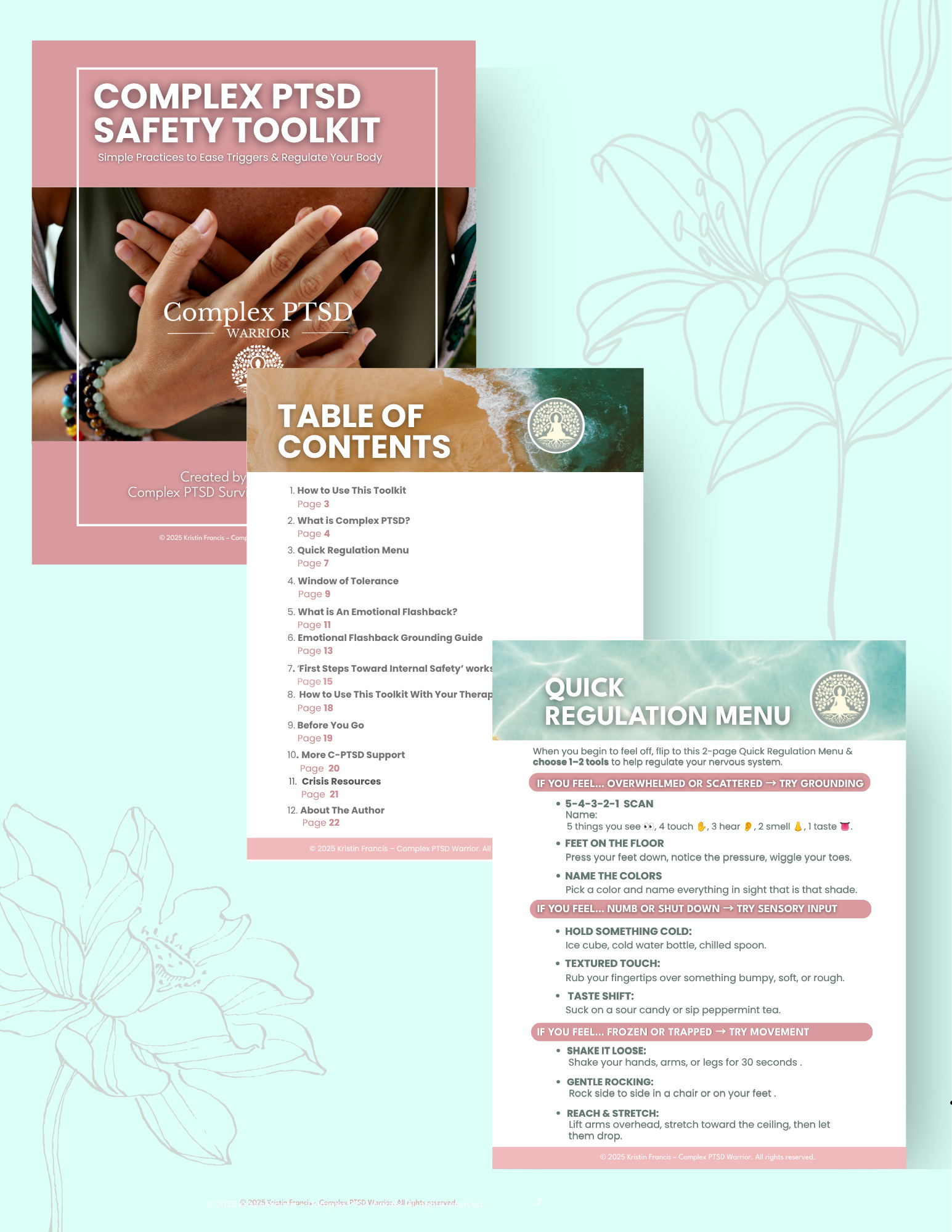
When you upgrade to an Annual or Founding tier, you’ll get instant access to my private 2018 journal entry below, our full archive of over 100 articles and a 100% free copy of the 22-page Safety Toolkit ($39.00 value) the moment it’s released.
🔐 For Paid Subscribers: My Private Journal Entry: Life Before I Knew It Was Complex PTSD
Here is a personal journal of what my life looked and felt like on the inside from December 2018, before I had language for Complex PTSD:
Keep reading with a 7-day free trial
Subscribe to Complex PTSD Warrior to keep reading this post and get 7 days of free access to the full post archives.