

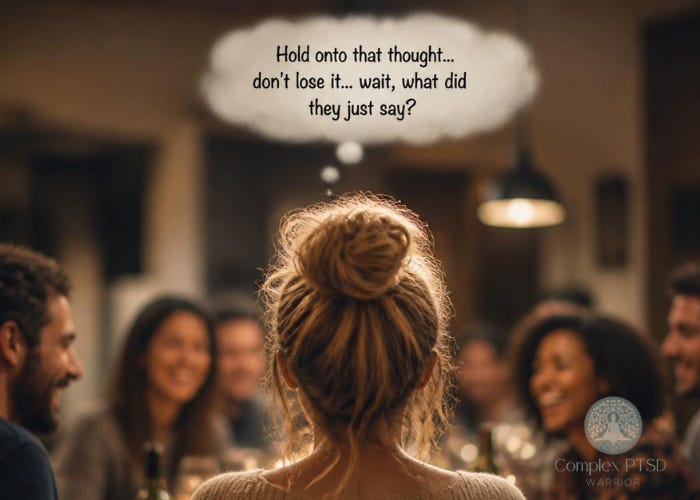
How C-PTSD Hijacks Everyday Conversations🫢
Why Your Mind Goes Blank Mid-Sentence + How to Get Unstuck in Real Time

By Kristin Francis | Complex PTSD Warrior
⚠️ Trauma-Informed Reminder
🌿 Go at your own pace: Pause or step away whenever you need to - that awareness is a victory in itself.
⚓ Ground your body: Take a deep breath, stretch, or orient to your room if physical tension starts creeping in.
❤️ Prioritize safety: Skip this post entirely if it doesn’t feel safe for your nervous system today - your emotional well-being always comes first.
🔒 Inside today’s Paid Deep-Dive at the bottom: 3 Simple Steps to check your in-the-moment mental age and 10 Screenshot-Ready Affirmations to release “lazy guilt.”
When you grow up with trauma, learning to trust your own voice is one of the hardest hurdles of all.
Up until just recently, I deeply struggled with this myself. Since my Complex PTSD diagnosis back in 2019, I have had so much to share with the world about Complex PTSD - both intellectually and experientially - yet whenever I tried to speak, my brain just didn’t trust what would come out.
Looking back now, I finally understand why: I wasn’t speaking from my grounded, adult self. I was still speaking from the unhealed, frightened child self inside me who never felt safe enough to articulate her truth.
If you’ve ever felt that same internal block, please know you aren’t broken.
You were just waiting for your adult self to finally take the wheel.🩷
🧠 The Neuroscience: Why Trauma Mutes Our Voice
Have you ever tried to share your thoughts, set a boundary, or express an opinion, only to feel your throat tighten, your mind go blank, or a wave of panic wash over you?
That isn’t a lack of confidence. It is a biological response controlled by your brain’s Security Guard (Amygdala).
🛡️The Protective Blueprint: When you grow up in an environment where violence, unpredictability or emotional danger is the norm, your brain learns a vital survival rule: Speaking up draws attention, and attention equals risk.
🔔 The Internal Alarm: Your brain’s Security Guard remembers every time expressing your authentic self wasn’t safe. When you try to use your voice today, it can misinterpret that vulnerability as an active threat and sound the alarm.
🔇The Offline Speech Center: High anxiety reduces blood flow to Broca’s area -your brain’s Speech Center. Your body literally prioritizes physical survival over your self-expression.
When your younger self was running the show, speaking up felt unsafe because, back then, it genuinely was.
🧩The Extra Layer: How C-PTSD Hijacks Everyday Conversation
When you live with C-PTSD, everyday communication can feel like running an internal marathon. While you are trying your hardest to actively listen to the other person, your brain is also:
📌 Holding onto a vital point you desperately don’t want to forget
🔊 Filtering out annoying or overwhelming background sounds
🚂 Worrying that you’ll lose your train of thought entirely
🎯 Carrying the heavy underlying pressure to say it just right so you aren’t misunderstood
I used to leave social gatherings or work discussions completely exhausted - not from the interaction itself, but from the immense mental energy it took just to track the conversation while managing the internal overwhelm, trying to keep up, losing my thoughts, and overthinking everything afterward.
What this looks like in everyday life:
🗣️The Delayed Script: Polishing what you want to say so thoroughly in your head that by the time you feel "ready" to speak, the moment has already passed
🚶♀️The Surprise Encounter: Running into a neighbor and having your mind go blank on how to end a conversation naturally.
🔁 The Post-Game Replay: Replaying a 30-second interaction with a cashier or coworker hours later, convinced you sounded “weird” or said something wrong.
That pressure to be understood is NOT a personality quirk - it is a trauma response. When your past tells you that being misinterpreted leads to conflict, rejection, or harm, your brain treats every single sentence like a high-stakes performance.
If you find yourself walking away from conversations feeling completely drained, or staring blankly because your brain hit capacity, please know: you aren’t failing at communication.
These are completely normal responses to managing a massive amount of internal noise all at once.
🦶⚓The Stealth Foot Anchor
During a surge of panic, your brain redirects blood flow away from your speech center and into your amygdala (your brain’s Security Guard) - leaving your brain’s speech center running on empty for a moment.
When you feel your throat tighten or your mind start to scramble mid-conversation, you don’t need a full reset. You just need a subtle, quick anchor to bring that blood flow back down into your body and signal to your brain that you’re safe.
Next time your brain hits capacity during a conversation:
Wiggle your toes inside your shoes or press your big toes firmly into the floor.
Mental check-in: Shift your awareness away from the panic in your head and down into the physical sensation of the ground beneath you.
Why this works: This subtle physical focus sends a quiet signal to your Security Guard that your feet are on solid ground and you are physically safe in this exact room. It buys your brain the 3 seconds it needs to pull your speech center back online.
Rewiring these neural pathways in our brains begins with two simple permissions: validating what you are experiencing and giving your brain the rest it’s been begging for- without a single drop of guilt.
Now let’s drop our shoulders and take a slow, deep breath in, hold it for a moment and slowly exhale.
We’ve got this 🩷
🌸 Continue Reading Below
The next part of this post is reserved for paid subscribers.
Inside our paid deep dive, you’ll unlock:
🌟 My Personal Field Test: How I learned to quiet my internal overwhelm and step into my grounded adult voice.
🌬️ A Nervous System Reset: A quick physical tool to help bring your speech center back online.
🔋 Dissolving Rest Guilt: 10 daily affirmations for when you feel you need permission to rest.
❤️“Healing isn't about never feeling overwhelmed again - it's about giving yourself permission to pause and breathe when you do.”
-Complex PTSD Warrior
💗 A Loving Reminder
Your voice matters - even when it shakes. Taking extra time to speak or finding your words slowly isn’t a failure, and you don’t have to say everything perfectly to be worthy of being heard.
And you do not have to earn your right to rest. Giving your nervous system permission to slow down isn’t “laziness.” It is essential, brave healing work.
If a younger, scared part of you is running the show today, that is completely okay too. Just whisper to that little part of you: 'I’m here with you now. You’re safe, and you don’t have to carry this alone anymore.’
Sending big hugs,
Kristin 💗
💬 This article draws on trauma-informed neuroscience and autonomic research, including Dr. Bessel van der Kolk’s research on how trauma deactivates the speech center in the brain and Dr. Stephen Porges’ work on Polyvagal Theory and nervous system safety.
📌 Save this post for the next time your brain goes blank or your voice feels frozen.
💬Your Thoughts…
When you feel unable to speak up - or when you try to let yourself rest - how old does that part of you feel in that moment? What is one small way your adult self can comfort that younger part of you next time that happens?
Corner of the couch? Where is your absolute favorite spot to cozy up, shut out the world, and cocoon when your nervous system needs a total break?
Leave a comment below - I read and reply to every single one! 🩷
📲 Share this with someone who needs a reminder to go gentle on themselves today.
👋 About Complex PTSD Warrior:
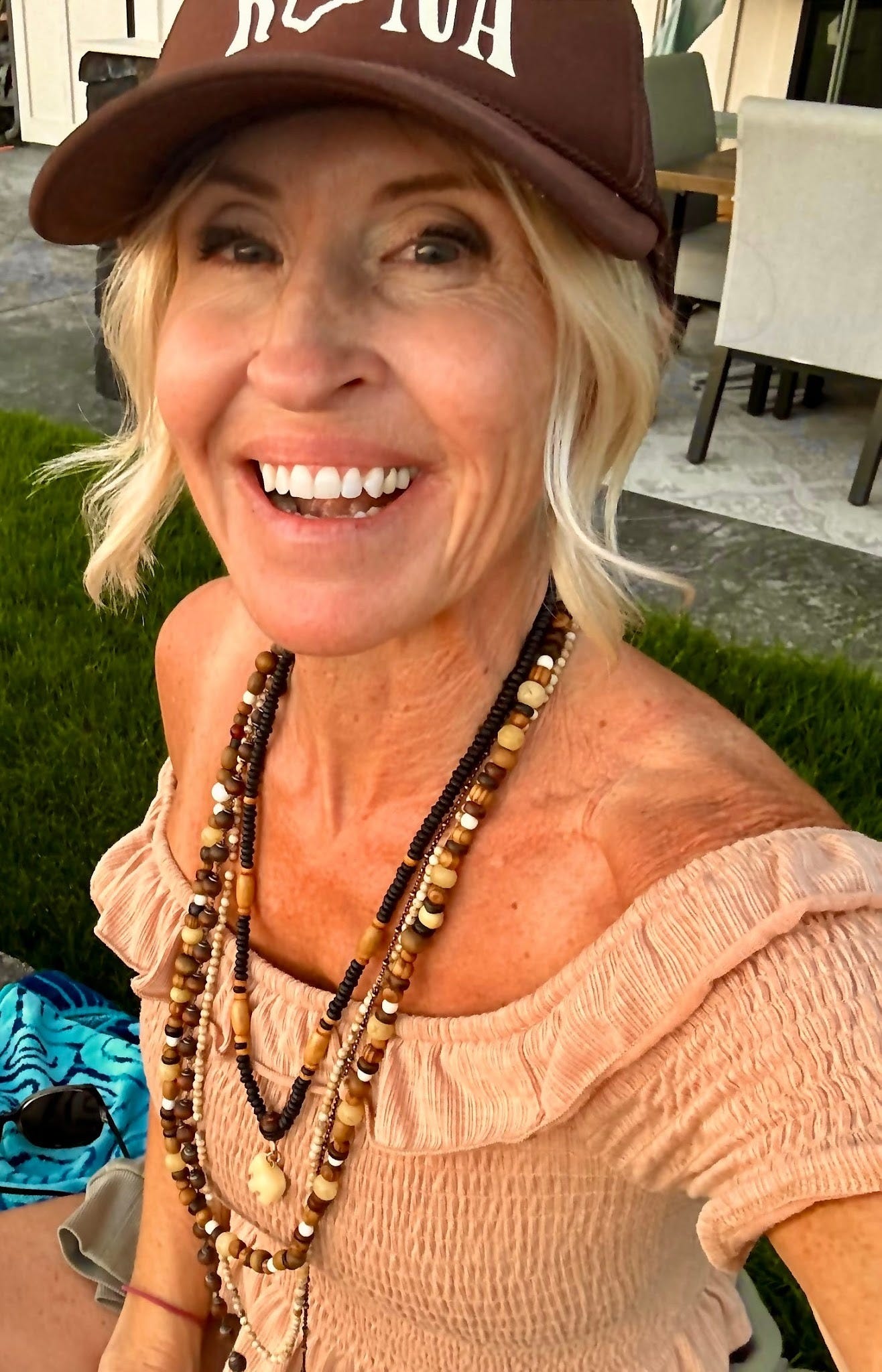
Kristin Francis is the voice behind Complex PTSD Warrior - a passionate advocate who translates the complex neuroscience of healing into everyday, relatable examples & solutions. Having walked the path of long-term trauma recovery, she intimately understands the exhaustion of survival mode. When diagnosed with C-PTSD in 2019, she immediately asked, “Why is no one talking about this?!” Realizing that millions of others were also navigating this heavy pain in silence, she made it her global mission to study the science of healing.
📝 A Note on format: Frequent line breaks, bolding, and emojis are intentionally designed to be “nervous-system friendly”—easy to scan and digest during high-stress moments.
Learn more about ART (Accelerated Resolution Therapy)
Disclaimer: The content shared here is for educational and informational purposes only and is not a substitute for professional mental health care, diagnosis, or treatment. If you’re in crisis or need immediate support, please reach out to a licensed mental health provider or crisis resource in your area.
Clinical Note: Accelerated Resolution Therapy® (ART) is a specialized, manualized intervention. The rapid resolution described in this article is a result of precise clinical protocols facilitated by an ART-trained therapist. For safety and efficacy, this process must never be attempted outside of a professional clinical setting by anyone not trained in ART.
If you are a therapist, coach, or educator and wish to use this content with clients or students, please contact info@complexptsdwarrior.com for professional licensing options.
© 2026 Kristin Francis – Complex PTSD Warrior. All rights reserved.
This publication is licensed for individual, personal use only. It may not be reproduced, distributed, or transmitted in any form, shared with others, or used in professional practice without prior written permission from the author.
I've lived this my whole life... it's soo hard sometimes. I'm actually crying because i always thought something was wrong with me but this really explains everything. Thank you for making me feel seen and supported today.
This seems to happen a lot these days. I imagine many people will feel seen after reading this.